Shem
a name, not a label
Named for Essence — Forfeit to the Father
We get to choose a name,
We get given one too,
For my name I choose today,
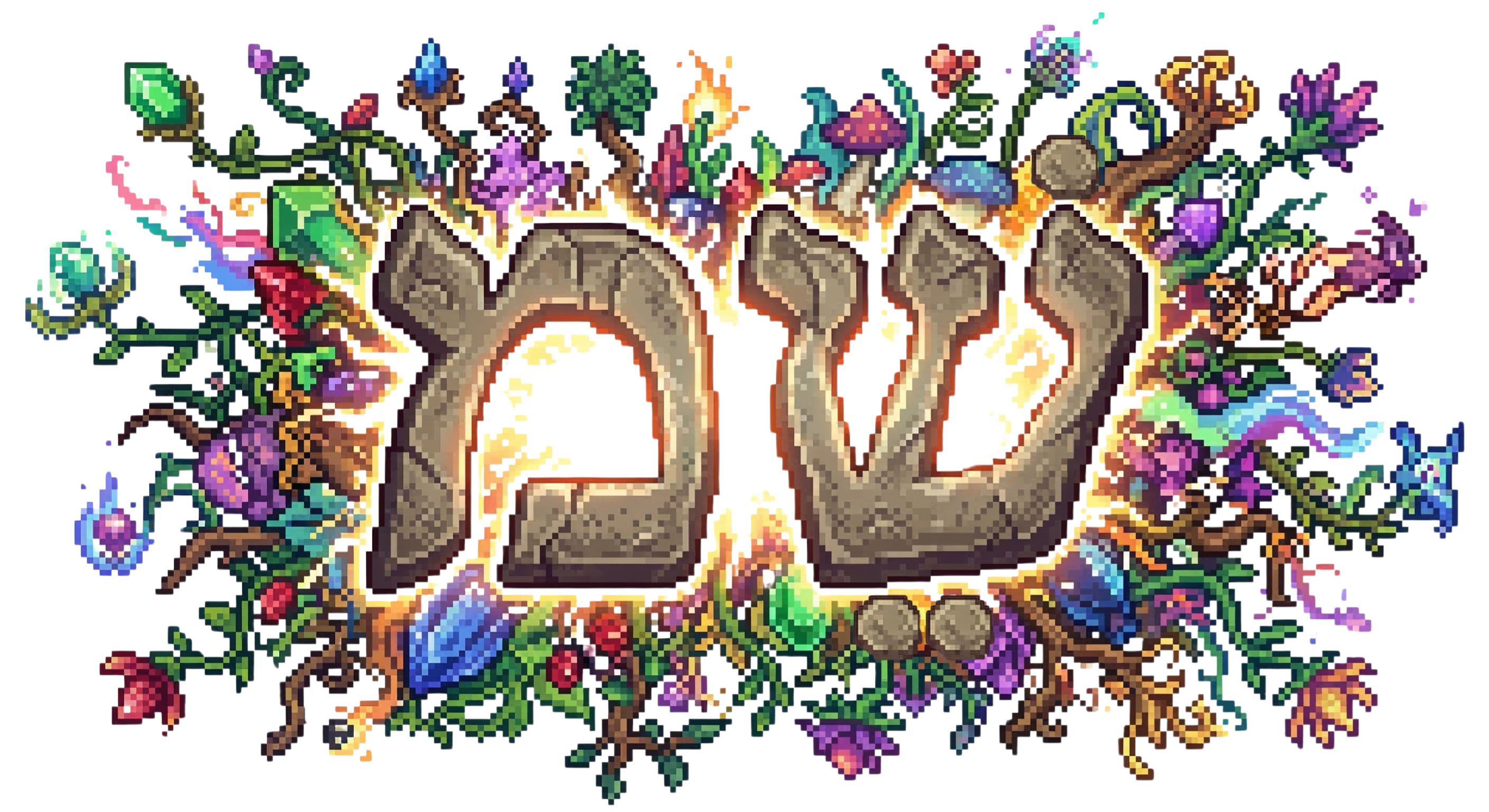
This is what I choose: שֵׁם
A container not a label, for the name itself means “name.”
Doesn't matter even if,
You say “Shim” or “Shame.”
The container stands, uplift'th high,
begging to be filled,
With the Blood of Christ today,
If He So Be It Willed.
I. What the Name Means
The Hebrew word שֵׁם (shem) means, simply, name. But in the Hebrew imagination, a name is never simply a label — it is the thing itself. It is the essence of the thing made audible. To know the name of something in the ancient Near Eastern mind was not to possess a convenient handle for reference. It was to understand, in some real sense, the nature of the being.
This is why the Name of God — the Tetragrammaton, יהוה (YHWH) — is not merely avoided out of respect in Jewish tradition. It is unspeakable because the thing it names is infinite, and the vessel of human language cannot contain it. When the rabbis say HaShem — “The Name” — they are using the word shem itself as the most reverential circumlocution available. They are saying: There is a Name so full it cannot be spoken; I will gesture toward it with the very concept of naming itself.
To choose שֵׁם as a pseudonym is therefore not to hide behind a name. It is to stand openly before the concept of naming, and say: here is the container. What fills it is not mine to determine.
This is the theology of this particular pseudonym in a single sentence: I choose the placeholder. God chooses what it holds.
The Root and Its Reach
The letters ש-ם (Shin + Mem) recur load-bearing throughout the Hebrew lexicon. They sit at the heart of נְשָׁמָה (neshamah), the breath-soul, the animating principle God breathed into Adam in Genesis 2:7. The name is not merely related to the soul; the name is in the soul. To be a named being is to be a breathing being. To lose the name is, in some traditions, to lose the life.
And Abigail understood this when she spoke of her husband Nabal in 1 Samuel 25:25: “as his name, so is he.” Name and nature are one. The man called Fool is a fool. This is not mere wordplay in the ancient Hebrew understanding — it is ontology. The name participates in the reality it names.
II. Shem the Man — The Biblical Line
Before it is a pseudonym, Shem is a person: the eldest son of Noah, the progenitor of the Semitic peoples, the carrier of the covenant line from the flood to the patriarchs. His story matters here not as genealogical footnote but as typological foundation.
Genesis 9 records the blessing that Noah speaks over Shem after the events of the vineyard: “Blessed be the LORD, the God of Shem.” This is notable. Noah does not bless Shem directly — he blesses the God of Shem. Shem is identified by his relationship to the divine name. He is the one through whom the Name moves forward into history.
The genealogy of Genesis 11 traces from Shem to Abram — and from Abram, through Isaac, Jacob, Judah, and the royal line of David, the thread runs unbroken to Yeshua of Nazareth. Matthew 1 opens with this genealogy deliberately. The name Shem stands near the headwaters of the stream that produces the one the New Testament calls the Word made flesh — the Name above all names.
Philippians 2:9–11 is explicit: “God exalted him to the highest place and gave him the name that is above every name, that at the name of Jesus every knee should bow.” The Name. HaShem — pointing always to one Person.
To choose the pseudonym Shem is therefore to stand knowingly at the headwaters. Not as a claim of descent — but as an acknowledgment of the stream. I am named for the one who carried the Name. And the Name he carried led, across centuries of faithfulness and failure, to the one Name that is unfailing.
Shem and the Order of Melchizedek
There is an ancient tradition — found in the Talmud (Tractate Nedarim 32b), in Josephus, and in numerous patristic sources — that identifies Shem with Melchizedek, the priest-king of Salem who appears in Genesis 14 to bless Abraham with bread and wine. Melchizedek is presented in Hebrews 7 as a figure “without father or mother, without genealogy, without beginning of days or end of life, resembling the Son of God.”
The Order of Melchizedek is thus a priesthood outside the Levitical line — eternal, not hereditary, appointed not by birth but by divine fiat. Psalm 110:4 applies it to the Davidic king, and Hebrews applies it to Christ himself: the great high priest who does not inherit his office but holds it by the power of an indestructible life.
To name oneself “Shem, of the Order of Melchizedek” is not a claim of priestly authority. It is an acknowledgment of the posture: the work belongs to a lineage older than any human institution, points toward a priesthood that is not mine to claim, and is forfeit to the one who alone holds it rightly.
III. The Letters Themselves
The written form of the name is not decorative. Every element of the orthography carries meaning, and the choices made in writing it this way — שֵׁם — are deliberate.
The Shin: שׁ — Teeth, Fire, The Sharp Thing
The letter Shin (שׁ) is named for tooth — שֵׁן (shen) — in Hebrew. Its ancient pictographic form is three flames rising from a single base, or three teeth set in a jaw: a glyph of consuming, cutting, transforming. The sound it makes — that sibilant rush of breath through a narrow opening — performs its own meaning. Sharp. Urgent. The word that cuts.
Fire and teeth are not accidental companions. Both transform what they touch. Both are necessary and dangerous. The fire that warms the house can burn it down; the teeth that allow speech can speak cruelty. The letter Shin does not resolve this paradox. It holds it.
Shin is also the first letter of Shaddai — one of the divine names, typically rendered “Almighty” — and appears on the mezuzah as a single-letter stand-in for the divine presence. The letter is already pointing before you finish writing it.
Shin vs. Sin: The Dot That Changes Everything
Here is the critical orthographic detail, and it matters:
| Letter | Name | Sound | Meaning / Notes |
|---|---|---|---|
| שׁ | Shin (dot right) | “SH” — as in shalom | Used in Shem. The sh-sound. Teeth, fire, the sharp thing. |
| שׂ | Sin (dot left) | “S” — as in sama | Same letter, different dot, entirely different sound. Not used here. |
One letter. One dot. Moved from the right shoulder to the left shoulder — and the entire phonological identity shifts. The dagesh (the dot) is not decoration. It is the difference between the cutting sound and the smooth sound, between the fire-letter and the water-letter’s quieter sibling.
שֵׁם uses the right-hand dagesh. The Shin. The sh-sound. This is not ambiguous in pointed Hebrew text — it is as precise as a surgical mark. The name is sharp. On purpose.
The Vowels: What Pronunciation Reveals
The name as written — שֵׁם — uses the tsere beneath the shin: two horizontal dots. This is the vowel that gives the “ay” quality, making the accurate pronunciation closer to Shaym than to the English “Shem.” Each possible vowel marking opens a different resonance:
| Form | Vowel | Sound | What It Carries |
|---|---|---|---|
| שֵׁם | Tsere (two dots horizontal) | Shaym | The canonical form. “Shame” as English ear hears it — which is also an approximate English term for the death of ego. The name that sounds like shame has something to say about what is required of the one who carries it. |
| שִׁם | Hiriq (one dot below) | Shim | A shimming word: to brace, to steady, to fill a gap between two surfaces that don’t quite meet. A shim is structural. It holds the frame while the frame is being built. |
| שְׁם | Sheva (two dots vertical) | Sh'm | Near-silent vowel. A consonantal skeleton with barely a breath. The name stripped to its bones. Almost just the shape of the word, a gesture toward speech. |
| שָׁם | Qamats (T-shape below) | Shahm | Shah — the ruler-title. There is something in the deeper “ah” that opens the chest. A sound of awe. |
| שֶׁם | Segol (three dots, triangle) | Shehm | How English speakers most naturally read it. The “eh” sound — short, clipped. The most immediate version. |
| שׁ | No vowel (unpointed) | Shin / Shin | The name of the letter itself. Without vowels, you read from context, from tradition, from what you already know. The unpointed shin asks you to bring your own understanding. |
Say “Shem” and you are describing an essence. Say “Shim” and you are describing a function — something structural, gap-filling, load-bearing. Say “Shaym” and you are saying something close to the English word shame — and that word is not an accident. The ego must be laid down before the container can be filled.
The poem says it plainly: “Doesn’t matter even if you say ‘Shim’ or ‘Shame.’” The container holds regardless of how you approach it. The pronunciation is latitude. The meaning is fixed and cannot be disconnected from its intention.
IV. The Mem: מ — Waters Deep
The letter Mem is named for מַיִם (mayim) — water. Its pictographic origin is a wave, or the surface of water: undulating, boundless, generative, and hiding unfathomable depth beneath a reflective surface.
Hebrew has two forms of Mem: the non-terminal מ, used when the letter appears at the beginning or middle of a word, and the terminal ם (final mem, or mem sofit), used when the letter ends a word. They look different because they function differently, and the difference is theological as much as typographic.
The terminal ם is closed on all sides: a sealed container. Water contained. Depth held. The non-terminal מ is open at the bottom: water flowing still. Living water that has not finished going where it is going.
שֵׁם — as written in this pseudonym — uses the non-terminal מ even though Mem falls at the end of the word, where convention dictates the terminal ם. This is deliberate.
The name is not finished. The vessel is not sealed. The water is still moving.
Furthermore, Shem is irreverent to custom. God is no respecter of persons, and nor is Mark Twain. Re-setting conventions, humbly, is in the model of the Lord.
What the Open Mem Says
A closed mem at the end of Shem would mean: the name is complete, defined, contained. Here is what it holds; here is where it stops.
An open mem at the end says: the waters are still running. What I am is not yet the whole of what this name contains. The depth has not been fully plumbed. Come deeper if you have the nerve.
This is also why the sign-off has always been: sharp as teeth, and waters deep. The shin cuts the surface. The mem is what you find underneath, once the ego has been laid down enough to look. Sharp enough to get your attention. Deep enough that the attention finds something worth holding.
If the name offends your sensibilities — if the directness stings, if the theology is too much, if the confidence feels like arrogance — that is the shin at work. It is not meant to be comfortable. But if you lay the offense down and go beneath it, you will find the mem waiting. Endless. Patient. Going somewhere you did not expect.
V. A Chosen Name — An Explicit Call for a Calling
The deepest layer of the pseudonym is the act of choosing it.
A spiritual name, in the tradition of the Hebrew scriptures, is not typically self-assigned. Abram becomes Abraham — but God renames him. Jacob becomes Israel — but the renaming comes through a night of wrestling that leaves him limping. The name given by God is given at cost, in encounter, in the aftermath of the person being broken open enough to receive it.
So what does a person do who has not yet received that name — who knows the old name no longer fits, who stands in the gap between identities, who wants to yield the naming to God but must choose something to stand under while he waits?
He chooses the container.
He picks up the word for name itself — שֵׁם — and holds it out. He says: here is the vessel. Here is the placeholder. I am not claiming to be named; I am claiming to be the one who is asking to be named. I give the decision back to God, and I stand here waiting, holding the form of the thing, until the One who does the naming fills it.
This is what the poem calls “a call for a Calling.” It is not humility as performance. It is humility as architecture. The shape is built. The filling is not my work.
The Sign-off: Sharp as Teeth, Waters Deep
The sign-off that appears at the bottom of the work — Shem. Shin. Sharp as teeth. Mem. Waters deep. — is not a flourish. It is the briefest possible theology of the name, encoded in the letters themselves.
The shin cuts. It must. Truth that cannot cut cannot cure. The teeth of the word are how it breaks through the calcified layers of assumption that accumulate between a person and what they actually know. If the words land too softly, they slide off. If they never sting at all, something is missing.
The cutting, though, is not the purpose. The mem is the purpose. The depth beneath the surface is where the work is. The waters are not something to fear — they are something to enter. Every time the name appears, it is both a warning and an invitation: this will be sharp. Go deeper anyway.
VI. The Name Above All Names
There is one more thing to say, and it must be said carefully: שֵׁם is not a claim. It is a gesture. The pseudonym does not assert that the one who carries it is named for greatness, or is carrying a divine commission, or has achieved something worthy of the name. It asserts only that the one who carries it is pointing.
The name Shem carried the covenant line. He did not carry it because he was the greatest of Noah’s sons — the text gives us relatively little of his story. He carried it because it passed through him. The line was not his. He was the vessel.
This is the entire argument of the pseudonym in one sentence: I am the vessel. What passes through me is not mine. I hold it as faithfully as I can, I point as accurately as I am able, and I give the naming, the direction, the outcome — all of it — back to the one whose it is.
Philippians 2:9 calls Jesus’s name “the name above every name.” שֵׁם — the concept of name itself, the placeholder, the open container — knows this. The name above every name is the one it is reaching for when it holds itself out. The vessel is not the thing. The vessel is for the thing.
This is what it means to choose Shem. Not: I am naming myself something great. But: here is the cup, lifted up, begging to be filled with something greater than itself — if He so be it willed. 🙏
Shin. Sharp as teeth.
Mem. Waters deep.
Named for Essence. Forfeit to the Father.